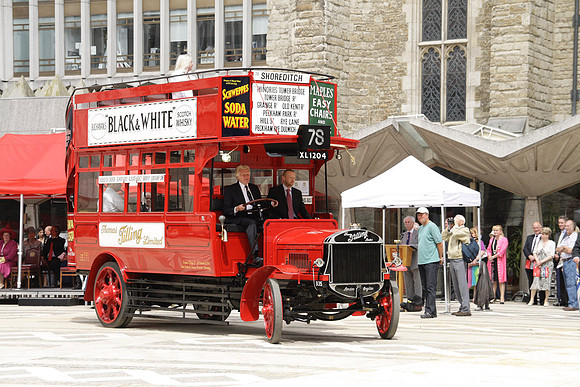
1922 Tilling-Stevens XL1204
TS3A petrol-electric superbly restored by the late Michael Banfield, seen here at the Cart Marking Ceremony at London's Guildhll on 17th July 2009. (Damon Cross)br/br/emDamon writes /em... An interesting entrant at the Worshipful Company of Carmen’s cart-marking ceremony at the Guildhall in August 2009 was Michael Banfield’s Tilling-Stevens TS3A No. 935 (XL1204), originally built for Tilling’s London fleet in 1922. The chassis is a TS3A petrol-electric built at the Tilling-Stevens plant in Maidstone. The body is a replica of the one originally built for the bus at Tilling’s coachworks in Wren Road in Camberwell (now the site of a supermarket). The TS3A-type replaced Tilling’s earlier TTA1’s, which were also petrol-electric; both types used a petrol engine, driving a generator which supplied current to a motor driving the wheels. Tilling settled on petrol electrics for a number of reasons. Firstly, early motor buses had unreliable transmissions, which were eliminated in the petrol-electric. It was also thought that horse bus drivers would find it easier to learn to drive a petrol-electric than to master a heavy clutch and gears. Lastly, Tilling was offered the patent on the design for a petrol-electric system by its designers, Percy Frost-Smith and Associates, for £3,000 and the L.G.O.C. agreed to finance this for Tilling. The TTA1s were originally manufactured at Bull Yard, with electrical equipment coming from the W.A.Stevens works in Maidstone; however, production later moved to the Maidstone factory, when Tilling gained financial control of Stevens and formed a new company called Tilling-Stevens. The TS3A was a bigger bus than the TTA1 it replaced, with a 48-seat body carrying 22 passengers inside and 26 outside.br/br/The TS3A introduced forward facing seats in the lower saloon for the first time, although these had been used on the LGOC’s K-types for a while before. Interestingly, the TSA3 retained the normal-control layout at a time when the LGOC was buying vehicles with forward-control. The TS3As also introduced a new livery style, with “Thomas Tilling Limited” fully spelled out on a white rectangle on an all-red livery. The TTA1s had previously carried an abbreviated “Thos. Tilling Ltd.” on the red bodywork. The last TS3As were withdrawn in 1931.br/br/This bus is relevant to the LT Museum as it is the same chassis type as the ex-Douglas chassis MN2615, which was formerly displayed up in the air at Covent Garden and now resides at Acton Depot. It also has a connection with the present day, as TfL is carrying out trials with buses using a small engine driving a generator to supply current to a motor to drive the wheels. First’s Wright-Hybrid No. WNH39001 also attended the cart-marking event. Around ninety years ago, Tilling was also complying with the all-red livery requirements for today’s TfL contracts!br/br/No TTA1s are thought to survive, but several of the TS-series survive from different fleets in various states of preservation. An example of the later, forward-control TS7 is preserved by Barry Weatherhead; this is the former Tilling XW9892 dating from 1925. This bus was originally built for the LGOC and is one of a batch of twelve single-deckers built for the 109 route originally wearing LGOC livery. The batch was later painted in Tilling livery in 1930; it retained this until withdrawal in 1932, when it was replaced by “T” type Regals.